Have scientists finally detected dark matter? – video
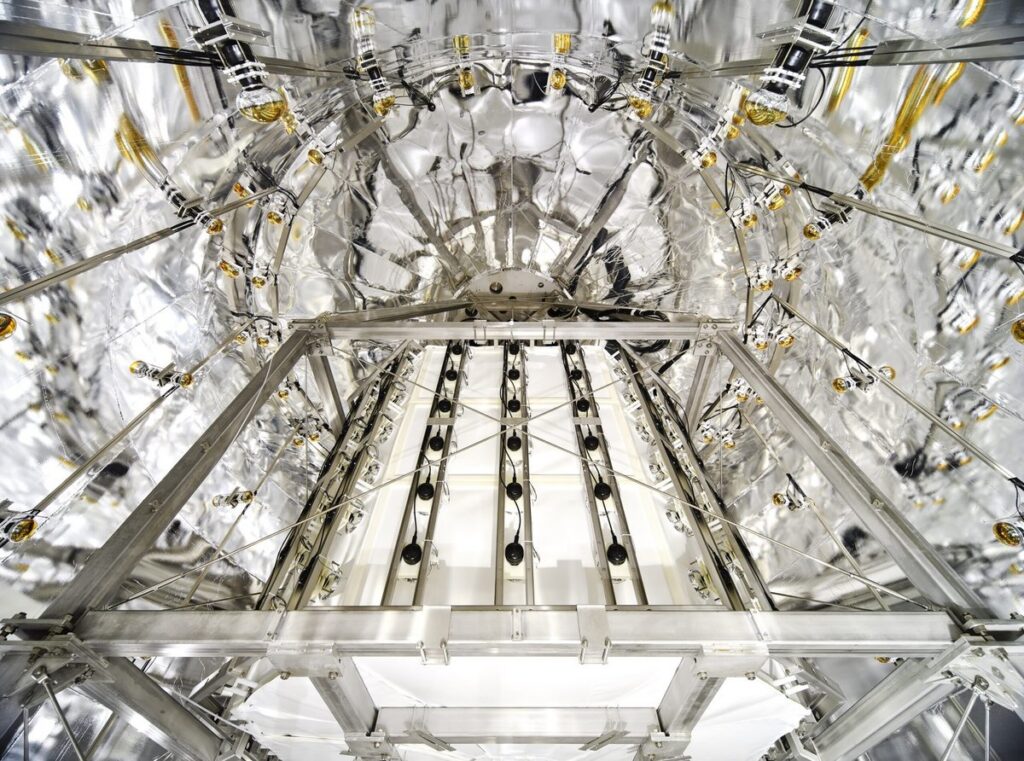
Image: Nature
ad slot · in-content video 16:9
Coverage
Wires & papers of record
- Nature, Published online: 01 September 2026; doi:10.1038/d41586-026-01985-9 An experiment spots an energy flash similar to that of the long-sought weakly interacting massive particle, or WIMP.
- A lone signal from an experiment in South Dakota doesn’t fit the profile of any other known particles, physicists say.
- Nature, Published online: 02 September 2026; doi:10.1038/d41586-026-02781-1 A single data point from a dark-matter detector could be the first discovery of the elusive particle. Plus, the grim progress of climate change and whether AI is homogenizing culture and cognition.
- The mysterious material has eluded scientists for nearly a century.
- Researchers may have discovered the signature of a bit of dark matter.
- For decades physicists have been puzzling over the enigma of dark matter. We think it makes up 85% of the matter in the universe, but the mysterious substance cannot be seen or detected, and we know about it mainly through observations of the gravitational effects it has on other things. But now…
- For decades physicists have been puzzling over the enigma of dark matter. We think it makes up 85% of the matter in the universe, but the mysterious substance cannot be seen or detected, and we know about it mainly through observations of the gravitational effects it has on other things. But now…
Coverage
- The XENONnT experiment, in its hunt for dark matter, has detected the rare, feeble glow of neutrinos smacking into electrons
- The world’s biggest dark matter search saw a particle it cannot explain
- Shadowy dark matter has eluded scientists for decades. The LZ experiment may have spotted one particle, called a WIMP, but more data is needed to check.
- An underground detector recorded a strange interaction pointing to a particle with some properties that signify dark matter. The detection is small but promising.
- Dark matter is an invisible substance that is said to bind the universe; scientists may have found new signs of it.
- Dark energy might be getting weaker. Scientists are wondering if interactions with dark matter in a “dark dimension” may be responsible.
- When physicists said they may have spotted evidence of dark matter almost 100 years after it was proposed as a theory, the internet lit up. Here's why we're searching for the thing that holds everything else together.
More coverage
- For the better part of a century, people have been trying to understand dark matter. This invisible substance makes up roughly 85% of the mass in the universe but has never been directly detected. Determining exactly what it is remains one of the biggest questions about our world.
- There are millions of species of bacteria and archaea on Earth, remarkably little is known about most of them. Now, researchers have mined the genomes of thousands of microorganisms preserved at the RIKEN BioResource Research Center (BRC) to find organisms that may be capable of capturing CO2.…
- Rice University researchers have used a magnetically levitated particle to search for ultraheavy dark matter, extending the hunt for some of the heaviest possible forms of the invisible matter thought to hold galaxies together. Led by Christopher Tunnell, associate professor of physics and…
- The most comprehensive catalog of exploding white dwarf stars ever assembled has revealed new clues about dark energy, the mysterious force driving the universe's accelerating expansion. Researchers at The University of Queensland's School of Mathematics and Physics have led a global effort to…
- Intense, brief flashes of radio light called fast radio bursts (FRBs) travel across billions of light-years to reach Earth, passing through a fog of matter along the way. The bursts' origins are unclear but may originate from highly magnetized dead stars called magnetars. The denser the fog…
- For decades, physicists have searched for dark matter, the invisible substance thought to make up roughly 85% of all matter in the universe. Although its gravitational influence shapes galaxies and the large-scale structure of the cosmos, dark matter has never been directly detected. Now, an…