Euclid’s H-alpha observations map where stars form in distant galaxies
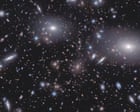
Image: The Guardian
ad slot · in-content video 16:9
Coverage
Wires & papers of record
- Unprecedented view of cosmos provided by Euclid mission throws up many more cases of gravitational lensing A mission to create the largest ever 3D map of the universe has revealed more than 900m galaxies in its first major data release together with about 15,000 potential cases of a phenomenon…
Coverage
- Lumina, a huge computer model laden with complex astrophysics, is giving scientists a breathtaking virtual view of the young universe
- The galaxies’ dark matter was ejected during a collision, but ironically, its absence is some of the best evidence of the elusive substance yet.
- The images are part of Euclid’s first major data release
More coverage
- UBC researchers have helped uncover 15,000 new potential strong gravitational lenses—the largest collection of these cosmic tools that help astronomers investigate dark matter.
- Euclid was launched into space in July 2023 to explore two of astronomy's biggest mysteries: dark matter and dark energy. The space telescope's first major data release covers some 1,900 square degrees of the sky, equivalent to around 14% of the area planned for the six-year mission and around 5%…
- Dark matter continues to evade direct detection. Its slower-moving particles might leave signals too faint for detectors to register, yet be more easily captured by planets and stars. As they accumulate inside these bodies, they could produce effects that existing instruments would allow us to…