Voyager 1 is about to achieve a cosmic first: one ‘light day’ from Earth
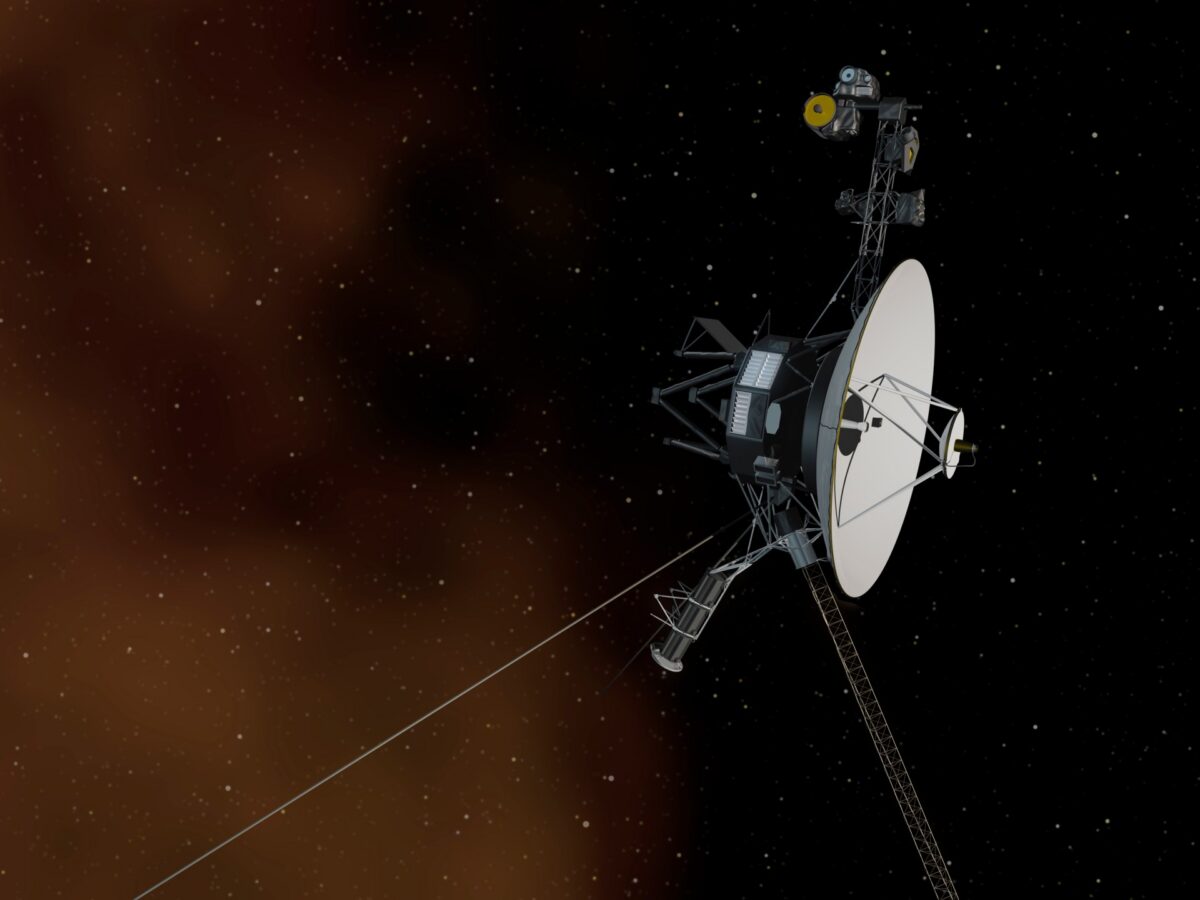
Image: NPR
ad slot · in-content video 16:9
Coverage
Wires & papers of record
- NASA's Voyager 1, which is the furthest man-made object from Earth, is set to reach a new milestone this week. On Wednesday, the probe will be roughly 16 billion miles from Earth.
- Nature, Published online: 17 November 2026; doi:10.1038/d41586-026-03672-1 Its power supply is faltering and most of its instruments are off, but the probe is still gathering data.
- Nasa sent the Voyager 1 and 2 probes into space almost 50 years ago to explore the outer reaches of our solar system. Now Voyager 1, the farthest human-made object from Earth, is about to reach a distance of one light-day away from our planet. To find out more about its astonishing journey,…
- Launched in 1977, the hardy spacecraft is still sending messages back home from a staggering distance in interstellar space.
- Nasa sent the Voyager 1 and 2 probes into space almost 50 years ago to explore the outer reaches of our solar system. Now Voyager 1, the farthest human-made object from Earth, is about to reach a distance of one light-day away from our planet. To find out more about its astonishing journey,…
- Voyagers 1 and 2 have gone farther and lasted longer than any other spacecraft that humans have sent out into the cosmos. Test your knowledge about their epic and ongoing journey.
- Since the spacecraft’s 1977 launch, our wonderful and terrible species has done great damage to our planet. Voyager has offered us a clear view of ourselves Imagine traveling nonstop for 49 years, alone in the dark with no destination in sight, powered by curiosity and engineering. Further imagine…
- The Empire State Building is seen illuminated in gold to celebrate NASA’s Voyager 1 spacecraft as it was about to pass one light-day away from Earth, a distance reached by no other human-made object, Nov. 17, 2026. The color gold represents the gold-plated copper phonograph record that is flying…
- NASA’s Voyager 1 probe, humanity’s farthest-flying spacecraft, has reached one light-day from Earth, after more than 49 years of constant travel. A light-day is the distance light travels in 24 hours, equaling about 16.1 billion miles (25.9 billion kilometers). The spacecraft achieved the…
Coverage
- The probe was launched in 1977 but it continues to relay space-related data back to a team of NASA scientists daily.
- When just saying 'hello' takes a two-day round trip, you're a light-day, or 26 billion kilometers, from Earth. Only one human-made object has ever traveled that far — and its journey into interstellar space continues.
- NASA’s long-lived deep-space mission will celebrate its 50th anniversary late next year. But first it’s passing a historic boundary, reaching a distance of one light-day, or nearly 26 billion kilometers, from Earth
- The space probe Voyager 1 is humanity’s farthest and best-known interstellar “message in a bottle”—but it’s probably not the last
- The spacecraft stores data on an eight-track tape, but it’s managed to stay in contact with scientists for decades. Now, it’s the first human-made object to travel a light-day away from Earth.
- It now takes 24 hours to send a message to Voyager 1, as it reaches a distance that's one light-day away from our planet.
- After traveling through the void of space for 49 years, Voyager 1 has hit a momentous milestone: the spacecraft is now officially one light-day away from Earth, which is, as NASA put it, "very, very far." The probe crossed the milepost on Wednesday at 5:16AM ET, and is now 16.094 billion miles…
- "They are pretty confident that it's going to last a long, long, long time..."
- The probe has explored both the solar system and the interstellar medium beyond during its decades-long journey.
- NASA’s Voyager 1 has reached a record distance of more than 16 billion miles from Earth, 49 years after its launch.
- Voyager 1 reaches one light-day from Earth, marking a historic milestone nearly 50 years after its 1977 launch.
- Launched in 1977, Voyager 1 has traveled farther than any other human-made object.
- The distance and forces shaping the venerable craft’s trajectory are mind-boggling reminders of the vastness of space.
- The stellar collision of a dying star with its smaller companion may have left behind a single, rejuvenated remnant, astronomers say
- NASA scientists gathered on Thursday to discuss the mission’s past, present and future
More coverage
- NASA's Voyager 1 is about to become humanity's first object to reach one light-day from Earth as it pushes ever deeper into interstellar space.
- How much do you know about managing your finances? And how much do you "think" you know?
- NASA's Voyager 1 probe, which has been traveling through space for nearly 50 years, hit a milestone distance of one light-day away from Earth on Wednesday.
- Astronomers have discovered a stellar system just 28 light-years from Earth that challenges our understanding of how stars live, die and interact as they evolve.
- NASA's Voyager 1 has phoned home from one light-day away, humanity's first emissary to cross this monumental threshold way out in interstellar space.